
Monitoring and Control Modules for DataNode Range

RS485 Module
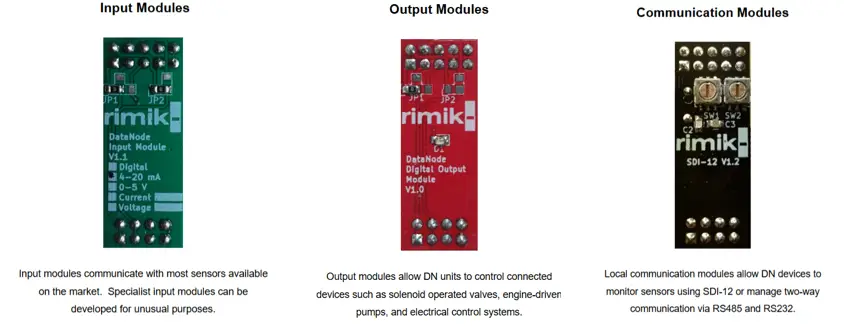
This module is designed to communicate via RS-485. Its primary purpose is to communicate with Modbus RTU devices and proprietary systems using a RS-485 serial link. Each module has it own internal address to identify it to the microcontroller. This allows users to mount several different types of communication modules onto the connect board if necessary. Each module has an address defined by the positions of by the positions of SW1 & SW2. The inclusion of the RS-485 module must be specified so that device specific firmware is included in the DN V3.2 firmware build. A terminating resistor is included on the module to eliminate reflections and the module is supplied with this switch in the OFF position. Multiple Modbus devices can be connected to a single RS-485 module but installers must be aware of ModBus RTU limitations (32) and the need for a terminating resistor at the end of the daisy chain.
SDI-12 Module
SDI-12 stands for Serial Data Interface at 1200 Baud Rate. This is an older protocol but is widely used for many sensors due to the standardisation achieved in communication and wiring. This Rimik module is specifically designed to communicate with SDI-12 devices. Each module has it own internal address to identify it to the microcontroller. This allows users to mount several different types of communication modules onto the connect board if necessary. Each module has an address defined by the positions of by the positions of SW1 & SW2. It is possible to connect a number of SDI-12 devices in parallel to a single SDI-12 module. Cable length can be up to 100m for a single sensor but will be reduced by the number of sensors installed. While the number of supported sensor addresses for SDI-12 has expanded to 62, the main limitation is voltage drop through the cable(s). Multiple SDI-12 modules can be mounted on the DN connect board to allow more convenient wiring points if required otherwise we recommend using a Rimik multi-socket connector.
4-20mA Module
This variant of the input module powers external devices which produce a small current as feedback. That current can range between 0 and 20mA and is used as an input value. The reading can be calibrated by the DN RTU to generate a result in stand formats such as kPa, mm, kg, litres per hour, uS, pH, volume etc. This module can utilise 3.3VDC , 5VDC or 12VDC selected by the positioning of jumpers on the rear of the module. The selection of voltage depends on the type of external device being read. Many common sensors with 4-20mA output can accept an input voltage between 9 and 30V DC so the stand input module is provided in this format unless specified otherwise. Module voltage will be marked appropriately on silk screen. Used for reading 0-20mA or 4-20mA inputs from: Pressure TransducersWater Level Sensors (tanks, channels, dams) Electrical Conductivity Sensors Secondary meters with 4-20mA output e.g. scale sets Specification:
Input Modules
This variant of the input module powers external devices which produce a variable as feedback. That voltage varies between 0 and 5V and is divided then used as an input value to the ADC. The reading can be calibrated by the DN RTU to generate a result in stand formats such as kPa, mm, kg, litres per hour, uS, pH, volume etc. This module utilises 5VDC but can be provided as a 10V input for special cases The selection of voltage depends on the type of external device being read. Many common sensors return between 0.5 and 4.5V as their full range and in that case the channel is calibrated for that range in firmware. Module voltage will be marked appropriately on silk screen. Used for reading 0-5V inputs from: Pressure Transducers Anemometers Magnetic Speed Sensors Turbidity Sensors Specification: Operating Voltage (fixed) Operating Voltage (switched) Maximum Input Current Input Voltage Level Sensors Temperature Sensors Accelerometers Soil pH.
Digital Output Module
A digital output module can utilise internal power sourced from the battery or an external source to control an external circuit by switching the low side of the circuit (V-/ground). For switching and powering external devices such as: External relays (DC) Small solenoid Valves (max 0.5A) Very small motors (DC) Panel and warning lights
12VDC Latching Solenoid Module
A 2 wire relay is utilised to output power on a two wire circuit to run devices up to 5A. The module switches both the negative and positive supply. The key difference with this module is that the negative and positive power supplies can be reversed allowing you to change the direction of current flow. The DN RTU can be configured to operate this module with pulsed output for use with latching solenoids and relays with pulse intervals from 0.01 seconds up to 4.5 seconds. Power is supplied from the connect board via either the battery or the External Relay Power connector. Internal or external supply is set via a jumper on the rear of the connect board. For switching or driving a device such as: 2 wire Solenoid 2 wire Latching Solenoid or Relay.
10A Relay Module
A high side switching relay is utilised to switch the positive power source to an external device. When the relay is OFF the external device is connected to ground but is isolated from the power supply. This module is designed with a higher power relay and can supply up to 10A. Power is supplied from the connect board via either the battery or the External Relay Power connector. Internal or external supply is set via a jumper on the rear of the connect board. For switching a device such as: Solenoid Valve External Relay (coil) Light or Indicator (low voltage) Siren or Strobe (low voltage) Small Motor (low voltage).
Series Switching Relay Module
A series switching relay opens and closes an external circuit. It does not supply the power to run the connected equipment. The relay utilised in this module can support a load up to 2.5A. For switching a powered device such as: Motor control circuit Lighting circuit (low voltage) External relay coil circuit Solenoid Valves (Externally powered) Small motor (low voltage)